


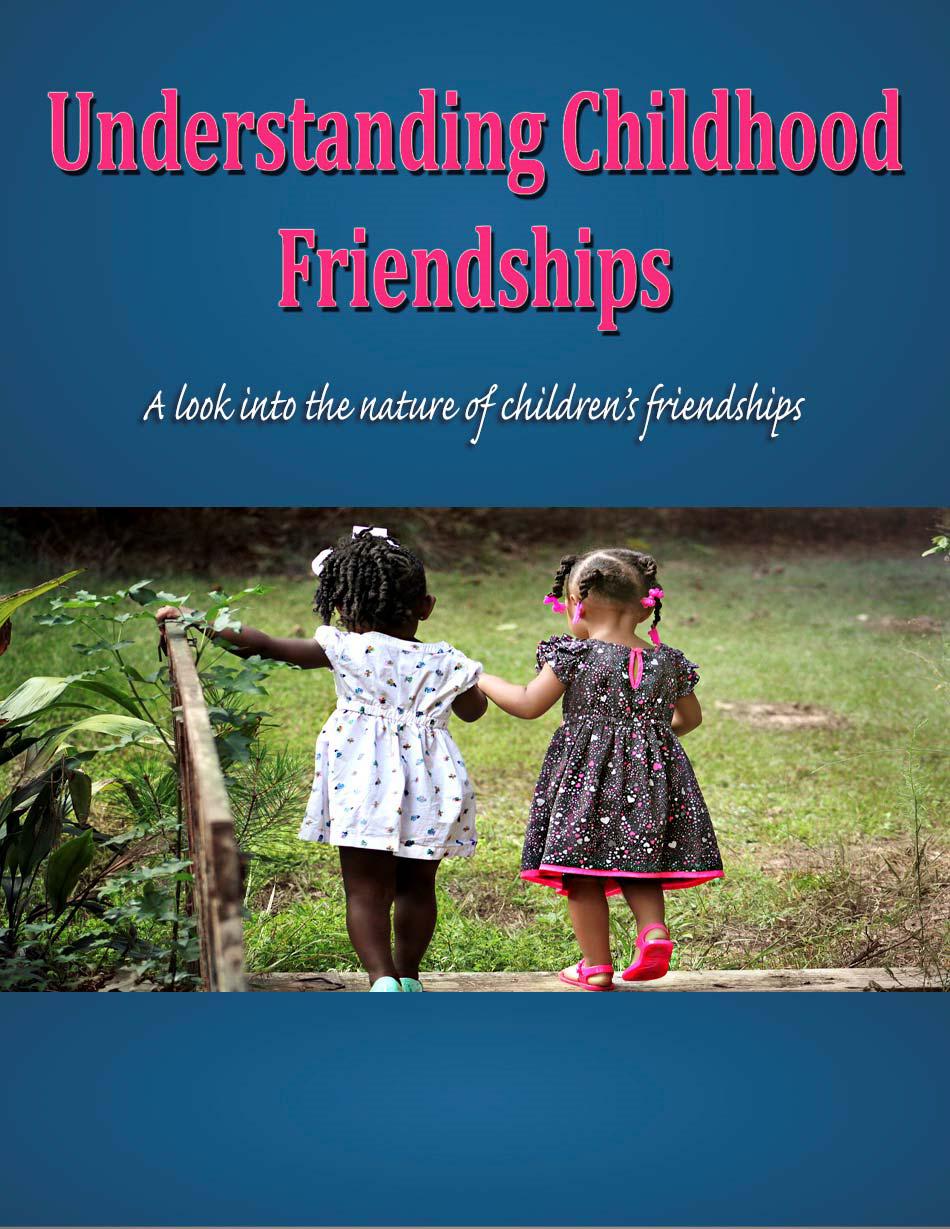

Description
As the great poet, John Donne wrote in the 17th century, “No man is an island entire of itself;
every man is a piece of the continent, a part of the main…”
No one can be alone in life. We need others to support us mentally, physically, emotionally and
spiritually. Relationships, and in particular friendships, can sustain us throughout our lives. Even
when romantic relationships end, we get laid off, or become ill, true friendships endure. When
times get tough, we know we always have someone to turn to who can help us in a practical
way or a supportive way, as we cry on their shoulder and then move on to deal with the issue
that has arisen.
But good friendships are not a matter of accident or chance. They come from skills cultivated
when we are younger, which can help us form life-time friendships even in our earliest years.
Like every other aspect of growing up, children need to learn friendship skills. They learn them
from parents and from their peers.
In this guide, we will be looking at the nature of children’s friendships, how they form, and how
we as parents can help ensure they are able to form lasting friendships and avoid negative
relationships such as bullying.
So, let’s get started with a look at the importance of friends.
THE IMPORTANCE OF FRIENDS
From the moment they are able to listen and understand, young children start to learn about
interpersonal dynamics within the family, and with children their own age – their peers. It is an
important aspect of growing up because it helps them understand interdependence and yet
enables them to become independent.
If they have one or more siblings in the household, this can help teach them about relationships
with people their own age as compared with adults. Children get a lot of educational benefit
from their parents, but the interactivity with other children at home and in social settings such as
play school, play days and more, helps them gain a range of skills that will put them in good
stead in their adult life.
For example, children learn communication skills – being able to say what they want and how
they feel. They ask questions, invite other people to play, and organize the activity into some
sort of sequences of events.
In the process of dealing with other children, they learn about emotions – their own and those of
others. They feel valued because they have friends, and learn how to try to preserve the
friendship. They learn to control their temper tantrums and deal with frustrations in a positive
way, so as not to argue with others or take their emotions out on them and drive them away.
Through this valuing of the friendship, they learn more complicated skills – such as avoiding
aggressive behaviors like hitting or biting, and being able to compromise or come up with other
ideas that might work.
They also learn how to co-operate with each other, and hopefully be honest. When game
playing, for example, they learn how to take turns, play the game according to the rules, and not
cheat. They also learn how not to be a sore loser.
Through friendships, they also learn that not everyone is the same and that people have
different thoughts and feelings they need to be aware of and sensitive to. They gradually learn
how to see things from others’ points of view and adapt their communication and play style to
different people.
They also learn new skills from their friends – things they might not have been able to do until
they saw them and decided to imitate them. This can be a bad thing sometimes, of course, if
kids “egg each other on” or teach each other inappropriate vocabulary; but again, this is where
strong parental guidance can help.
Modeling in Your Own Household
Children take their cue from their parents, so if you don’t treat others with respect, cheat at
games and swear like a trooper, they are going to think this behavior is normal and acceptable
and do the same. However, this can get them into considerable trouble at school and in social
situations.
In some cases, they might even bring home a friend who acts like that. It is important not to
overreact, but rather, to teach by example. Saying please, thank you, being kind, offering
compliments and supportive praise all “grease the wheels” of human interaction. So too does
learning when to speak up about an issue, and when to keep silent for the sake of harmony and
the preservation of the relationship.
The Importance of Friendships Starts Early
How to make friends, and keep them, are two of the main developmental tasks children need to
learn from their preschool years and upwards. Studies have shown that these skills help prevent
children from having psychological and school problems later in life. Yet studies have also
shown that some children as young as three are already having serious problems negotiating
relationships with other children.
About 5 to 10 percent of young children will go on to experience persistent problems, such as
social exclusion and rejection, or physical or verbal harassment from their peers – either due to
their own actions, or the bullying of others. Peer relationship difficulties in a child’s early years
are unfortunately a powerful predictor of future emotional and behavioral problems. These can
include:
Emotional problems such as loneliness, anxiety and depression
Behavioral problems, such as physical or verbal aggression, hyperactivity or defiant
behavior
Physical issues, such as being bullied, or bullying others
Children with developmental difficulties are at particular risk because they develop more slowly
than their peers and often are not allowed to or don’t get as many chances to interact with
children their own age. As children get older, they might also become more judgmental and start
to make fun of the person they once enjoyed having as a friend.
Being made fun of or bullied can lead the child to become socially withdrawn. Adults can help
with conflict resolution, positive reinforcement of good friendship skills, and discipline in relation
to aggressive or bullying behavior.
Day care centers and schools might also use programs that try to improve the children’s social
behavior skills and their peer relationships. They will use varied activities and try to involve
everyone in the efforts, staff and parents alike. If you are concerned your child is very shy
and/or having difficulties with peer relationships, you might ask about training, or look up
information online.
But what constitutes a problem? In order to know this, we have to have an idea of what is typical
of friendships amongst children at different ages in order to determine if there are any issues
that need to be addressed. Let’s look at the typical friendship patterns at different ages in the
next section.
THE TYPICAL FRIENDSHIP PATTERNS AT DIFFERENT AGES
In the same way that babies learn to roll, crawl, walk and run, so too do their friendship skills
develop over time. As they get older, they start to view friendships differently and in a more
emotionally mature and connected manner.
The Stages of Children’s Friendships
Child psychologists tend to use the 5-level model developed by Robert Selman to determine
what is typical for each age level and how your child’s relationships should mature over time.
Level 0 Friendship — Momentary Playmates (Approximate Ages: 3-6 Years)
These relationships are all about fun and playing, with little thought for emotional connection
and a lot of appreciation for the fact that they are nearby and they can do things together that
they like. Conflict can arise if they don’t get their own way, but they will gradually learn that
cooperation leads to better results than storming off. They can usually only see their own
perspective, so it can surprise and even anger them if one of their playmates expresses a
different opinion.
They may show some preference for some friends over others, but in general, the friendships
come and go as moods and activities change.
Level 1 Friendship — One-Way Assistance (Approximate Ages: 5-9 Years)
Children are still pretty selfish at this age, wanting their own way, but they start to understand
that friendship means more than just playing together, and that it can be a two-way street. They
want nice things from their friends and will be prepared to be nice in order to get them, but they
don’t really focus on their own role and responsibilities in the relationship.
They will sometimes tolerate others they don’t really like if they are nice to them, and they will
sometimes “bargain” with others by saying, “I’ll be your friend if you do this!” or “I won’t be your
friend if you do that!”
This can lead to some drama and perhaps even bullying, so it is important to watch out for
domineering behavior and foster cooperation.
Level 2 Friendship — Two-Way, Fair-Weather Cooperation (Approximate Ages: 7-12
Years)
At this point, children are much better able to grasp different points of view other than their own,
but that does not always mean agreeing with them or putting the other person first. They will still
try to get their own way if they can.
However, at this point they also start to take more of an interest in what is fair. They are also
more willing to take turns, cooperate and do what another person wants if they get what they
want.
At this point they also start to judge themselves and others, discriminating between “good” and
“bad”. They want to be liked but become nervous that they are “not good enough” or something
is “wrong” with them if they have friendship issues.
They can also be jealous within friendships, especially if the friends they usually spend time with
start to branch out and make other friends. This is where peer pressure can really start to kick
in, with a child doing whatever they can to be the same as everyone else in order to be
accepted and not stand out from the crowd.
In many cases, this desire to conform will lead the children to create secret clubs with rules, and
above all, who is allowed in the club and who isn’t. This can be fun for a time, but painful if they
break the rules or someone says they don’t want them to be part of the club any more.






Reviews
There are no reviews yet.